AI Phone Answering for Restaurants: Stop Losing Orders to a Ringing Phone
The average restaurant misses about 150 calls a month, most of them during the rush. Here's what those calls cost, what AI phone answering actually does, and how to roll it out without hurting the guest experience.
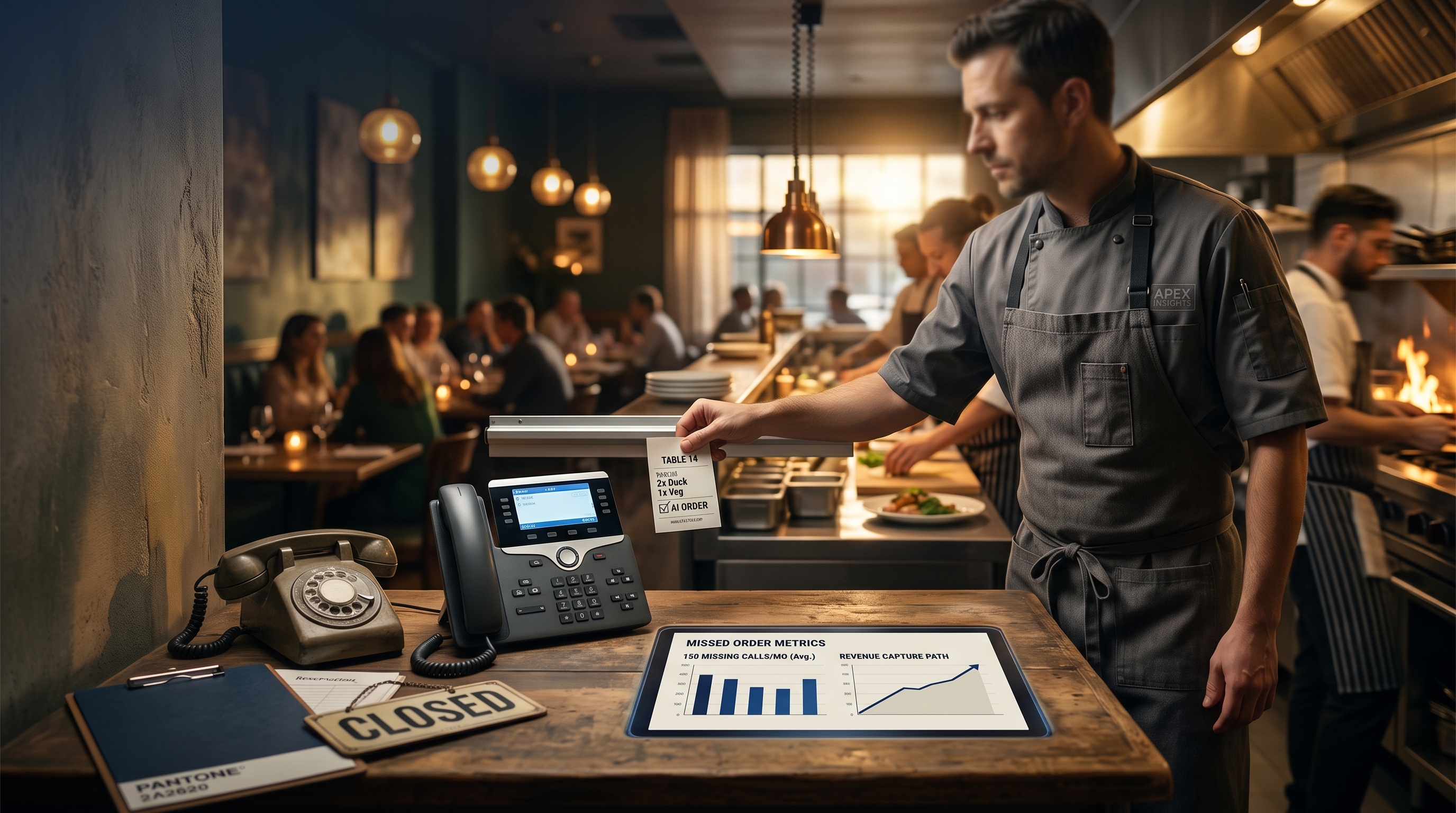
It's 6:45 on a Friday. Your host is seating a six-top, the kitchen is slammed, and the phone rings. Nobody can grab it. That caller wanted a table or a $60 takeout order. Four rings later they hang up and dial the place down the street.
Missed calls are the quietest revenue leak in the restaurant business. You feel the busy nights, but you never see the money that walked. Here's what unanswered calls actually cost and how AI phone answering closes the gap, with the tradeoffs spelled out honestly.
The numbers are worse than most owners think
The average restaurant misses around 150 calls a month (QSR Magazine; Washington Hospitality Association data). Scale that across roughly 700,000 U.S. locations and QSR Magazine estimates the industry is leaving $20.1 billion in lost revenue on the table annually.
Three details make it sting:
- Roughly 60% of missed calls are people trying to place an order or book a table. Not spam, not vendors. Actual money on the line.
- Timing is the enemy. Between 5 and 8 PM, the average restaurant misses 32% of incoming calls, and only about 1 in 3 callers tries again (QSR Magazine). The phone goes unanswered exactly when each call is worth the most.
- A missed call often means a lost customer, not just a lost order. A regular who switches to a competitor after one unanswered call can represent hundreds of dollars in lost annual value.
Independent industry work backs this up. Revmo's State of Restaurant Calls 2026, built from 12,091 real call recordings, found QSRs miss 40% of calls and that a single 50-location chain can lose an estimated $3.65 million a year to missed calls alone. (This is a vendor study; treat the exact dollar figures as directional, but the pattern is consistent across independent sources.)
Why your best staff can't fix this
This isn't a training problem. Peak call times are peak service times. You have the fewest free hands precisely when the phone rings most, and asking a host to choose between the guest at the counter and the ringing phone means one of them always loses. Nearly half of restaurants report they don't have enough staff to meet demand, so "just answer the phone" isn't a plan.
What AI phone answering actually does
A restaurant voice-AI system answers every call instantly and handles the routine work:
- Answers 100% of calls, 24/7, including during the rush and after close
- Takes orders and pushes clean tickets to your POS; some systems take payment over the phone
- Books, confirms, and modifies reservations, capturing party size, time, and special requests
- Answers menu, allergen, hours, and directions questions without pulling a person off the floor
- Handles unlimited simultaneous calls and routes edge cases to your team
The honest tradeoff: voice AI is excellent at high-volume, repetitive calls, meaning takeout orders, reservations, and FAQs. It is not a substitute for hospitality. Complex complaints, large catering negotiations, and anything requiring judgment should route to a human. Used well, it removes the friction that erodes service; used lazily, it frustrates guests. Set it up to hand off gracefully.
What it costs
Entry pricing for restaurant voice AI starts around $199/month for many vendors, typically flat-rate rather than tied to hours. Compare that against even one recovered $45 order a day and the math moves quickly, but insist on a trial and check how it handles your actual menu and modifiers before committing.
A rollout plan that protects the guest experience
- Measure your miss rate for one week. Most phone systems can report missed and abandoned calls. If yours can't, that's your first clue.
- Start with overflow and after-hours only. Capture the calls you're already losing to voicemail. Lowest risk, immediate upside.
- Connect it to your POS and reservation system so orders and bookings land where your team already works. No second screen to babysit.
- Review transcripts weekly. Fix the menu items and questions it fumbles. This is where the accuracy gets built.
- Expand to full coverage once you trust the order accuracy and the human handoffs.
FAQ
Will it sound like a robot? Modern restaurant voice AI sounds natural and can be tuned to your brand's tone. Callers often can't tell, but always test it against your real menu first.
Can it take payment over the phone? Some systems integrate directly with your POS to take card payment for pickup and delivery, which captures prepaid orders you'd otherwise lose.
Does it replace my staff? No. It takes routine calls off the floor so your team can focus on in-person guests and complex requests. Most operators use it to stop missing calls, not to cut headcount.
What does it cost? Often starting around $199/month, usually flat-rate. Compare on total monthly cost at your real call volume, and run a trial before signing.
What happens to complicated calls? Well-configured systems route complaints, large catering, and anything ambiguous to a human instead of guessing.
Where Apex fits
At Get Apex Insights, we set up AI phone systems for independent restaurants and multi-venue groups, connected to your POS and reservations, tuned to your menu, and configured to hand off to your team when it matters. If your phone is costing you orders, let's plug the leak. Start at getapexinsights.com.
Sources: QSR Magazine ("While the Phone Rings, Restaurants are Losing $20 Billion," 2026); Washington Hospitality Association; Revmo State of Restaurant Calls 2026 (12,091 call recordings); National Restaurant Association staffing data; Loman AI and Hostie AI 2026 missed-call analyses.