Restaurant Labor Cost Percentage: The Number That Should Hit Your Inbox Every Night
How to calculate restaurant labor cost percentage the way your accountant would, what a good number looks like by concept, and how to see it every night instead of at month-end.
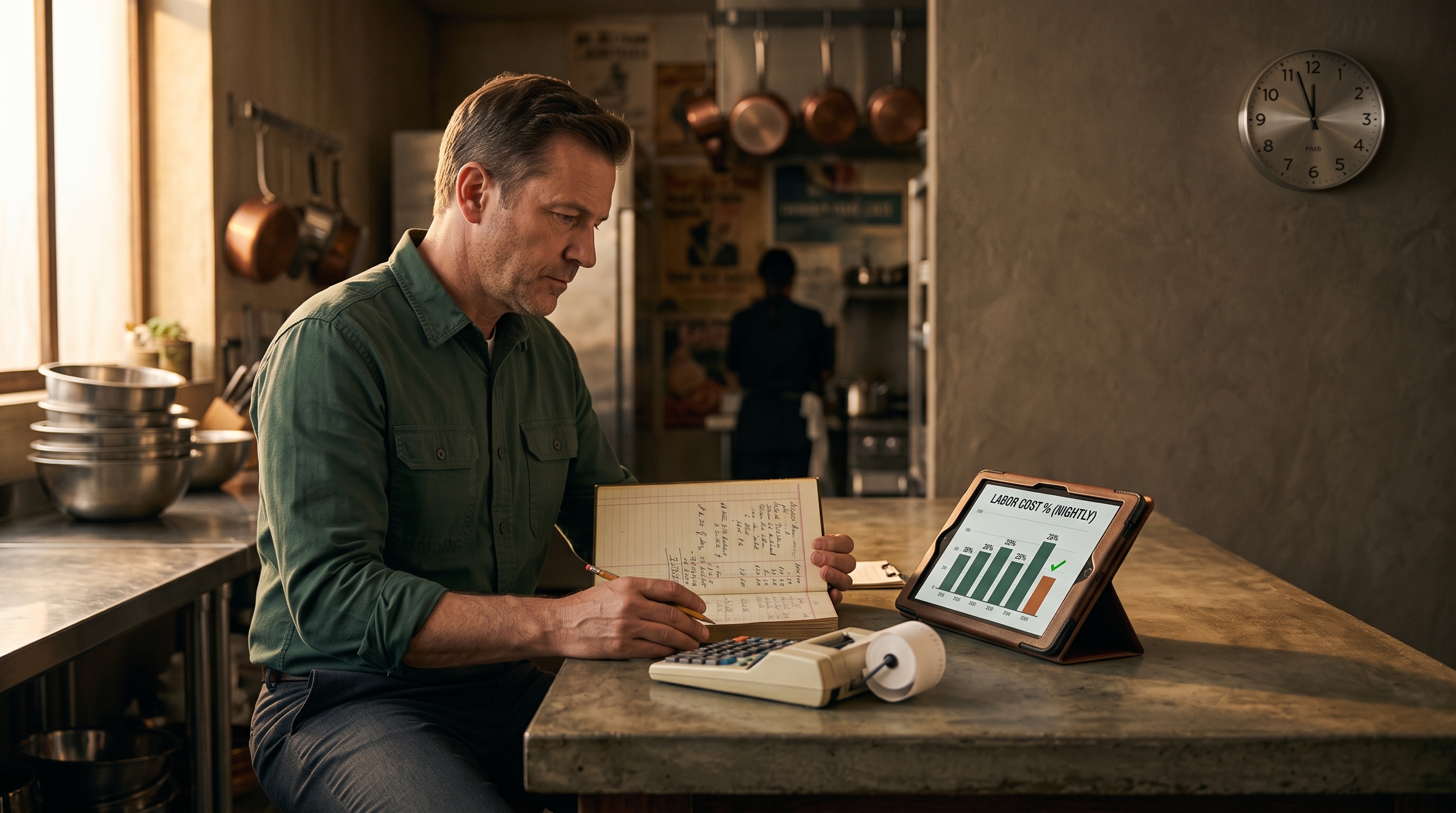
It's 11:40. The last table just paid. You open three tabs: sales in the POS, hours in the scheduling app, last period's payroll estimate. You do some math on the back of a prep list and land on a labor number you only half believe.
Most owners live here. The formula isn't the hard part. The hard part is that the inputs sit in three places, and the one number that should shape tomorrow's schedule shows up three weeks later on a P&L.
This page covers one formula, one way to think about targets, and one nightly habit.
The formula that doesn't lie, if you feed it honestly
Labor cost % = (total labor cost ÷ net sales for the same period) × 100
Quick example, with illustrative numbers: $15,000 in labor against $50,000 in net sales is 30%.
Simple enough. Both halves have traps.
The top number: fully loaded labor
Total labor cost is what it costs you to have people in the building, not what shows up on their paychecks. Count:
- Gross hourly wages, front and back of house
- Salaries, including managers and the chef (and you, if you draw one)
- Overtime
- Employer payroll taxes: FICA, FUTA, and your state unemployment tax (SUTA)
- Workers' comp
- Benefits, paid time off, and bonuses, to whatever extent you offer them
Pick what's in, write it down, and keep it the same every period. A number you calculate the same way every night is worth more than a perfect one you calculate twice a year.
Wages-only labor % understates your real cost. FirstHR puts the gap at roughly 12 to 18 percent; Stockcount's calculator guide puts it at roughly 10 to 15 percent. Illustrative math: $13,000 in gross wages on $50,000 in sales looks like 26%. Add a 15% load for taxes, comp, and benefits and the same week is about $14,950, or just under 30%. Same restaurant, same week, four points apart.
This matters most when you compare yourself to a benchmark. The National Restaurant Association's figures include benefits. If your number is wages only, you aren't beating the benchmark. You're measuring something else.
The bottom number: net sales, same period
Two rules.
Use net sales. Gross sales minus comps, discounts, and voids. Sales tax was never yours; leave it out.
Match the periods. A week of payroll over a day of sales tells you nothing. If labor covers Monday through Sunday, sales cover Monday through Sunday. If you're looking at tonight, use tonight's clocked hours at their loaded rate against tonight's net sales.
Do tips count?
Generally, no. Tips the guest paid are the guest's money going to your staff. They aren't your labor expense, so they stay out of the top number. Putting them in inflates your percentage and sends you chasing a problem you don't have.
What does count is what you paid: the cash wage, plus the employer taxes that come with it. One wrinkle catches people. Reported tips are treated as wages for employment tax purposes, so you owe the employer share of Social Security and Medicare on them even though the money never passed through your hands. That tax belongs in your labor cost. The tips don't.
Tip credit rules are a separate matter, and they vary a lot. Federal law sets a baseline (the Department of Labor keeps the current tip rules here), but a number of states don't allow a tip credit at all, which puts front-of-house labor on a different footing from the same restaurant one state over. There is also a federal credit for employer taxes paid on certain tips (the §45B FICA tip credit).
None of this is tax advice. Ask your payroll provider or CPA how tip credit and the FICA tip credit apply in your state, and whether you're claiming what you're owed.
What "good" looks like, by concept
The range you'll see almost everywhere is 25 to 35 percent of sales. Toast cites it as the typical range. FirstHR breaks it down further: roughly 25 to 30 percent for quick service and fast casual, 30 to 35 for casual and full service, and up to 40 for fine dining.
That's a starting frame. Here's the primary data behind it.
The National Restaurant Association's 2025 Restaurant Operations Data Abstract, built on 2024 financials from more than 900 operators, reports salaries and wages including benefits at a median of 36.5% of sales for full-service and 31.7% for limited-service. Both are well above the roughly 33% and 28% the same report averaged across its 2010, 2013, and 2016 editions.
The more useful cut is who made money. Full-service operators who reported a pre-tax profit in 2024 ran labor at a median of 34.2%. Those who reported a loss ran 42.9%. In limited service it was 30.0% against 34.1%.
So the median full-service restaurant was running labor above the level the profitable ones ran. Average is not the target.
The NRA is clear that these figures aren't meant as standards for any single restaurant, and that's the right way to read them. Your target depends on:
- Service model. Table service takes more hours per cover than a counter.
- Hours. A seven-day, two-daypart operation carries labor through slow stretches a dinner-only room never sees.
- What's in your labor line. If managers are in yours and out of your buddy's, your numbers will never match, and neither of you is wrong.
- Your state. Wage floors and tip credit rules move the baseline before you've made a single scheduling decision.
Your own trend line beats any benchmark. A room at 33% that was at 30% six months ago has a problem no industry table will show you.
Labor % and prime cost
Prime cost = food and beverage cost of goods sold + total labor. Divide by net sales for the percentage.
Owners watch both because the two trade off. A scratch kitchen buys cheaper raw product and pays for it in prep hours. A place that buys more finished product runs lean on labor and heavy on food cost. Judge either number alone and you can talk yourself into a bad decision.
The rule of thumb you'll see cited: prime cost around 60% of sales, in a band of roughly 55 to 65 depending on concept. Toast frames it as about 60%, split more or less evenly between food and labor. FirstHR puts the target at 60 to 65 and notes that the NRA's full-service medians add up to 68.5%, which goes a long way toward explaining a 2.8% median pre-tax margin.
A 30% labor number next to 30% food cost is a healthy restaurant. The same 30% next to 38% food cost is not.
Why monthly is too late
A monthly labor number tells you what already happened. The shifts that produced it are four weeks gone, the money is spent, and nobody remembers why Tuesday the 9th ran two people heavy.
Meanwhile, tomorrow's schedule is getting written from a feeling about how last week went.
The operators who hold the line look at labor against sales by day, and ideally by shift. Four numbers, every night:
- Net sales
- Labor dollars
- Labor %
- Covers (or sales per labor hour, if that's how you think)
Then one comparison: the same day last week, or the same week last year if you're seasonal. A slow Tuesday in February against a busy Tuesday in December tells you about the calendar, not about how you staffed.
You can only fix a shift while you still remember it.
How operators actually get the number tonight
There are three honest ways to do this.
1. A spreadsheet and a POS export. It works. It costs nothing but someone's time. It also depends on that someone. The week they're on vacation, or the night close runs long, the number doesn't get done, and that's usually the week you needed it.
2. The labor module in your POS or scheduling tool. Good option if your sales, time clock, and schedule all live in one system. It gets harder when they don't, and most of these report wages, not loaded cost, so you'll still need your own load factor.
3. A desk that sits on top of what you already run. It connects to your sales, schedule, and payroll, and sends the summary to you instead of waiting for someone to build it.
That third one is what we make. On the Apex desk, clocked labor shows live against sales, so you can see at 7:30 whether the floor matches the book. At close of business, an email lands with sales, labor, and covers. Nobody compiles it. Your POS stays where it is. It's the wages view — apply your load factor from the section above for the accountant's number.
FAQ
How do I calculate restaurant labor cost percentage?
Divide total labor cost by net sales for the same period, then multiply by 100. Total labor cost means fully loaded: wages, salaries, overtime, employer payroll taxes, workers' comp, and benefits. Example: $15,000 in labor on $50,000 in net sales is 30%.
What is a good restaurant labor percentage?
Most guidance lands between 25 and 35 percent of sales, lower for quick service and higher for full service. In the National Restaurant Association's 2024 data, profitable full-service operators ran a median of 34.2% and profitable limited-service operators ran 30.0%. The right target depends on your service model, hours, state, and what you include in the labor line.
Should I include tips in labor cost?
Generally no. Tips paid by guests aren't your expense. Do include the wages you paid tipped staff and the employer payroll taxes you owe, including those on reported tips. Tip credit rules vary by state, so confirm the details with your payroll provider or CPA.
How often should I check labor %?
Daily, and by shift if you can. A monthly number arrives too late to change anything. Looking at sales, labor dollars, labor %, and covers each night lets you adjust tomorrow's schedule while you still remember what happened.
What is prime cost vs. labor cost?
Labor cost is what you spend on people. Prime cost is labor plus food and beverage cost of goods sold. A commonly cited healthy range for prime cost is about 55 to 65 percent of sales depending on concept. Watch both, because food and labor trade off against each other.
Pick a definition and stick to it
Decide what goes in your labor number. Write it down. Calculate it the same way every night, against that night's net sales. Then use it tomorrow morning when the schedule is in front of you and you can still move someone. A number that doesn't change what goes on the schedule isn't doing anything for you.