
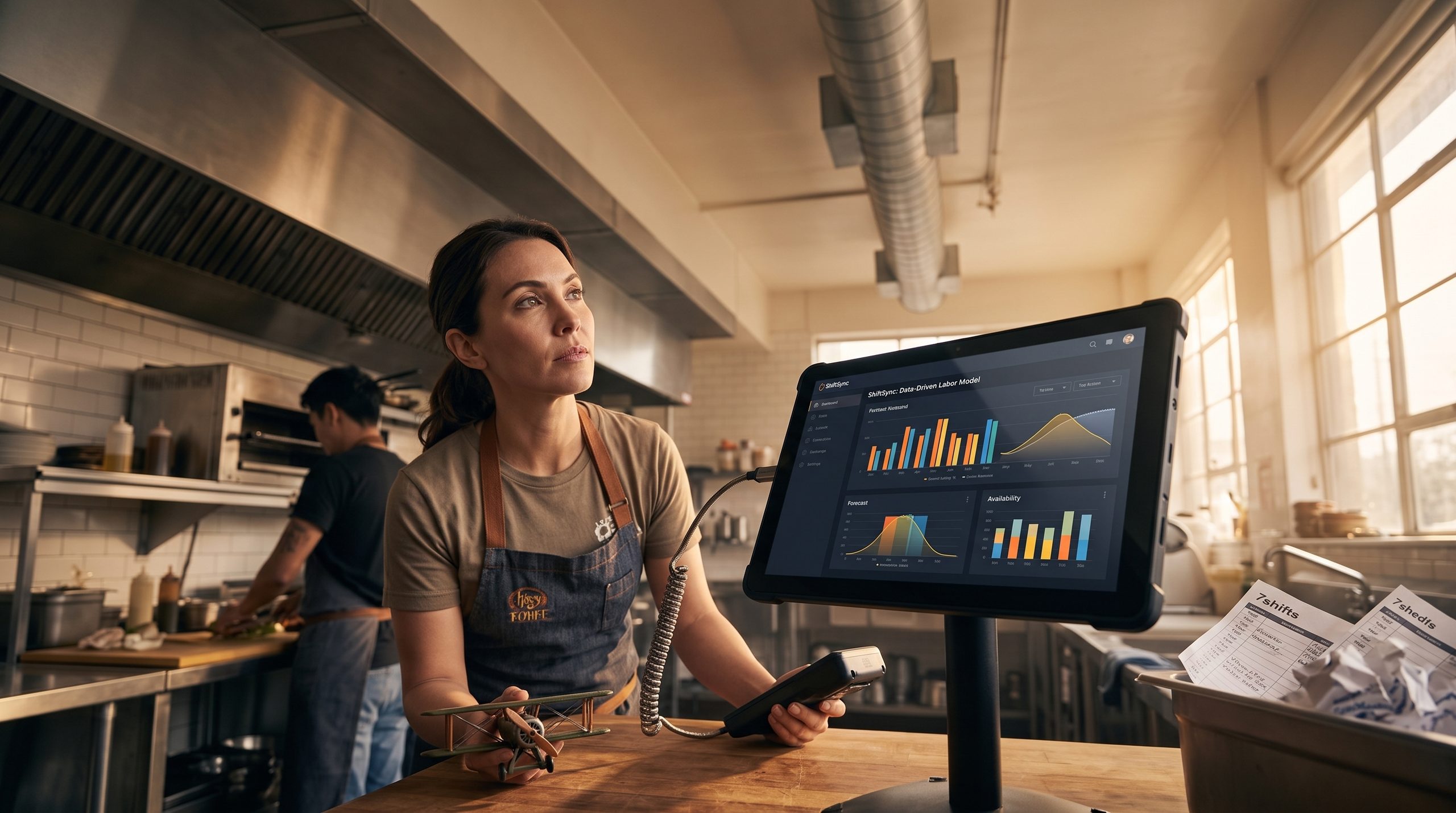
We Just Replaced 7shifts: Scheduling Must Be Led by Data, Not Availability
Operators are replacing 7shifts because availability-first scheduling breaks under volatility. Apex Insights builds schedules from sales forecasts, labor models, and real-time demand signals so coverage flexes with actual business needs.
Restaurant demand is volatile, margins are thin, and labor is your largest controllable cost. If your schedules start with employee availability and end with last-minute patchwork, you’re paying for it in overtime, guest wait times, and manager burnout.
At Apex Insights, we’ve recently replaced 7shifts for multiple operators because the availability-first model can’t keep up with the spikes and slides of real demand. Even as 7shifts announces growth and product updates, operators are asking for something different: schedules that begin with the forecast and flex in real time, not just a prettier template or a bolt-on swap tool. For context, see 7shifts’ recent announcements here: https://www.prnewswire.com/news-releases/7shifts-accelerates-growth-and-industry-leadership-with-major-customer-expansions-product-innovation-and-workplace-recognition-302704760.html.
1) Why operators are replacing 7shifts — availability-first breaks under volatility
Availability-first scheduling feels cooperative, but it backfires when traffic shifts day by day and hour by hour. Before switching, operators told us:
- Understaffed peaks drive ticket times up, comps up, and guest satisfaction down.
- Overstaffed troughs inflate labor as a percent of sales.
- Managers lose hours reworking lineups after reservations surge, weather shifts, or events pop up.
- Swap tools that aren’t integrated push firefighting into texts and side channels.
In short: availability-first breaks under volatility. Data-led models right-size labor to demand and protect margins. That’s why operators are asking for a true 7shifts alternative built to align labor decisions with revenue reality.
2) Data-led scheduling that starts with the forecast
Schedules should be built by math, not preference. Apex Insights generates the plan from your demand curve and then fits availability to it.
- Scheduling driven by sales forecasts, labor models, and real-time demand signals.
- Role-based labor models convert forecasted sales and covers into staffing targets by station and skill—servers, line cooks, expo, bar, host, dish, prep.
- Predictive compliance, cost, and coverage checks run in the background so every schedule you publish is optimized for labor cost percentage, guaranteed rest, minor rules, and overtime risk.
Managers start with a labor blueprint tuned to expected demand. Availability then fills the right people into the right times—never the other way around.
3) Seamless shift swapping and flexible pools
Turnover, call-outs, and life happen. The answer isn’t manual scramble mode; it’s systems that self-correct.
- Integrated shift swapping that is seamless, not bolted on.
- Shift pools that flex with actual business needs.
- Real-time guardrails that reconcile swaps against the forecast so you don’t drift into over/understaffing while solving a single absence.
You get the agility of a marketplace with the discipline of a forecast.
4) Connected intelligence across operations
Connected intelligence — scheduling that’s aware of the full picture.
- POS trends and item mix: when average check or labor-heavy menu mix shifts, schedules adjust station staffing, not just FOH headcount.
- Reservations, waitlist, and events: fast-changing cover pace tightens staffing windows to where service pressure actually shows up.
- Traffic and weather: rain, heat waves, game days—local signals that move guests; we ingest them automatically so your labor reacts on time.
- Kitchen capacity and prep: line throughput and prep backlogs inform station-level staffing and prep timing to avoid choke points.
5) Operator outcomes that matter
Teams don’t switch for features; they switch for results felt on the floor and proven in the P&L.
- Lower labor cost variance. Operators report meaningful reductions in variance to plan as schedules are built on real demand and maintained as swaps occur.
- Faster service and higher throughput. Right-sizing by station reduces ticket times and increases table turns without burning the team.
- Fewer call-ins and schedule churn. Demand-backed schedules reduce last-minute changes and stabilize the week.
- Less manager time reworking schedules. Publishing moves from hours to minutes because forecasting, modeling, and compliance happen up front.
- Better team engagement. People see fair, predictable shifts and a transparent path to picking up hours via pools, not politics.
6) Getting started with Apex Insights (555 S Edgewood Ave)
You don’t need a six-month rollout to prove value. We stand up a pilot quickly, on your data, with live stores.
- Discovery and targets: align on goals (labor cost percentage, ticket times, overtime reduction, speed-to-publish) and pick pilot units/roles.
- Data connections: POS, reservations/waitlist, events; payroll/HRIS; optional traffic and weather APIs.
- Build your labor model: translate service standards into staffing curves; set thresholds for coverage, skills, and cross-training.
- Publish and iterate: generate the first forecast-driven schedule in hours; monitor live demand; the system suggests adds/cuts and pool activations; managers approve with one tap.
- Prove the lift: compare pilot periods to prior weeks on variance, overtime, ticket times, and schedule changes; standardize wins and expand.
Why not just optimize availability-first?
Because availability is a constraint, not a starting point. Leading operators are flipping the script:
- Start with the demand forecast and labor model.
- Fit availability to demand using rules that protect service standards and labor targets.
- Keep the plan whole as swaps happen with integrated, rules-aware workflows.
- Use pools and connected signals so the schedule self-corrects as reality changes.
Yes, 7shifts has a broad footprint. But when volatility is the norm, operators choose a platform built around forecasting, dynamic labor modeling, and real-time signals—not availability templates and after-the-fact edits. That’s why we’re being asked to replace it, and why teams that switch don’t go back.
The bottom line
- Start every schedule with the forecast, not availability.
- Keep coverage aligned to actual business needs with dynamic pools and integrated swaps.
- Power decisions with connected signals from POS, reservations, traffic, weather, and kitchen capacity.
- Measure outcomes in variance, speed, overtime, and manager time saved.
See why operators are replacing 7shifts—book a data-led scheduling demo with Apex Insights (555 S Edgewood Ave) to generate a forecast-driven schedule for your next period and align labor to real demand.