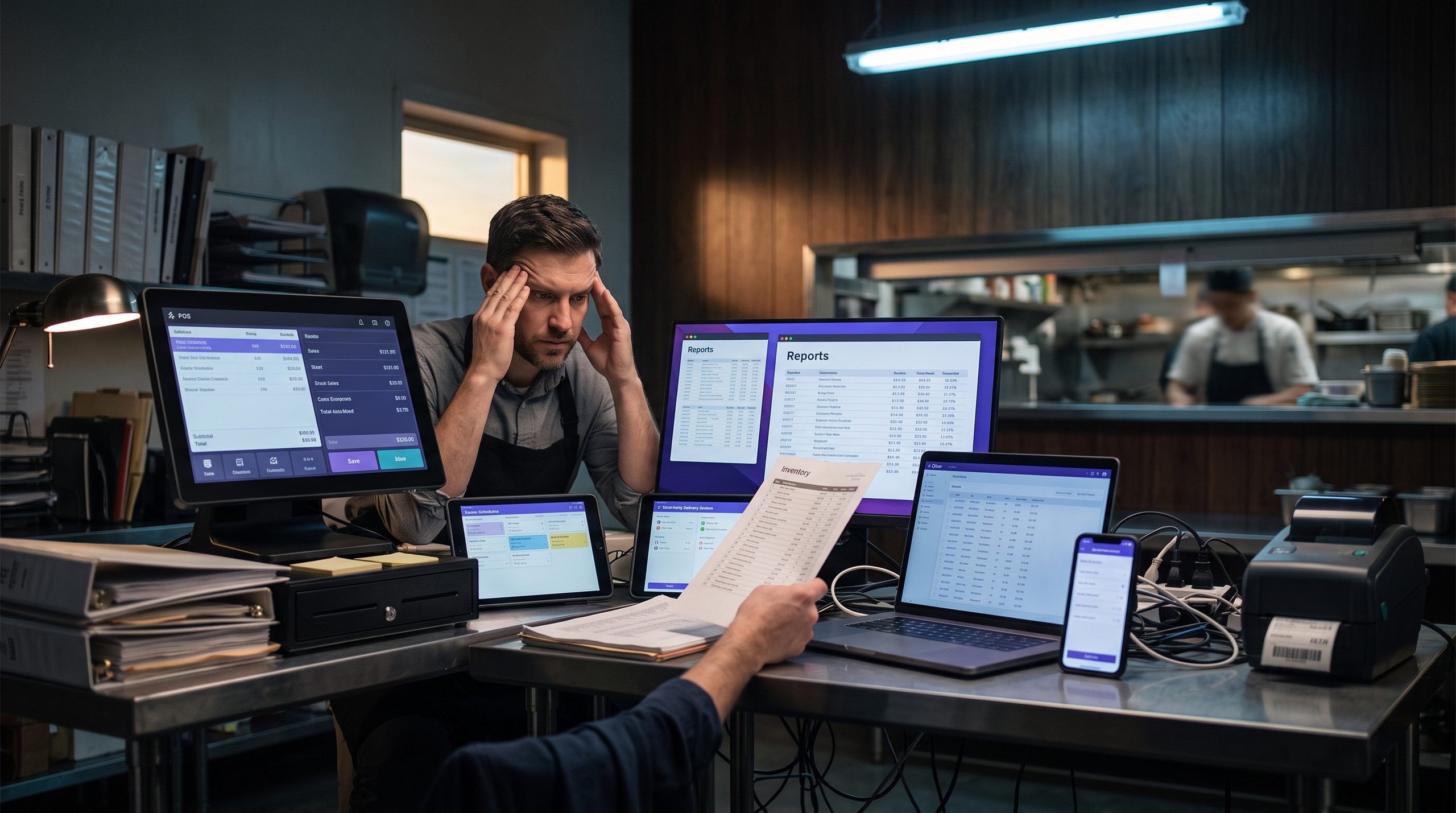
Your Restaurant Runs on 10+ Software Platforms. They've Never Had a Conversation.
Restaurants run 10+ disconnected software platforms — and the gap between them quietly costs operators 20-30% in revenue leakage. The fix isn't more software. It's an integration layer that gives every system one version of the truth.
Walk into the back office of almost any multi-unit restaurant and you'll find the same thing: a POS system, a labor scheduling tool, an inventory platform, a reservations system, a payroll processor, a delivery app or three, a marketing tool, a review management dashboard, maybe an accounting package on top. Ten-plus systems. All running. None of them talking to each other.
Here's the problem that creates: each one has its own version of "busy."
- Your POS says covers are up 15% this hour.
- Your labor scheduling tool is still running last week's forecast.
- Your inventory system thinks it's a slow Tuesday, because that's what the last three Tuesdays looked like.
- Your marketing platform is optimizing a promo off last month's sales numbers.
Meanwhile, you — the operator — are supposed to make a staffing call, a par-level call, a "should we push the special tonight" call, in real time. Off of data that isn't real time, and isn't even internally consistent.
This is the cross-system gap
We call this the cross-system gap, and it's not a minor inefficiency. It's a direct hit to the P&L. Restaurant365 does accounting. Toast does POS. Neither was built to reconcile itself against the other, or against your scheduling tool, or your inventory counts. Every one of those disconnects is a decision made on stale or partial information — and stale decisions compound. Operators who run this way are typically leaking 20-30% in revenue they never see itemized anywhere. Not from bad food. Not from poor service. From software that can't agree on what's actually happening in the building right now.
Think about what that leakage actually looks like on the ground:
- Overstaffing Monday lunch because the schedule was built off gut feel, not this week's actual demand signal.
- A delivery item quietly losing money on every order because nothing is watching margin in real time.
- A slow shift nobody flagged until the labor % showed up on a report three days later.
- A marketing push timed to numbers that were already out of date when the campaign went out.
None of these show up as a single dramatic loss. They show up as a fraction of a point here, a percent there, quietly, every single week, until they add up to real money.
The fix isn't more software
The instinct is to buy another point solution — a better forecasting tool, a smarter scheduling app, one more dashboard. That doesn't close the gap. It adds another system that doesn't talk to the others either. What actually closes it is an integration layer: something that sits across your POS, your delivery apps, your payroll, and your reservation system, and reconciles them into one clean, current data stream. Not a report you pull at the end of the week — a live signal you can act on during the shift. That's the difference between a pile of software and an operating system. An operating system doesn't replace your POS or your accounting platform. It connects them, agrees on one version of "busy," and gives your team — and your AI agents — a single source of truth to act on.
What one version of the truth actually buys you
When your systems finally agree with each other, the decisions get faster and cheaper to make:
- Staffing gets built off actual demand signals — sales history, weather, local events — instead of last week's guess.
- Margin gets watched order by order, so an underperforming delivery item gets flagged this week, not next quarter.
- Marketing runs off what's actually selling right now, not a snapshot from thirty days ago.
- You get one dashboard to approve decisions on, instead of three logins and a spreadsheet stitching them together.
That's the job. Not another tab. One brain, watching everything you've already invested in, so the next staffing call, the next par order, the next marketing push, is made on what's actually true — right now — not on whichever system happened to update last.